
Anecdotal evidence from American Apparel to natural gas pipeline operator El Paso Corp. suggest that banks are reluctant to lend. There are still plenty of problematic assets on banks' balance sheets.Big banks may face another wave of losses from credit cards, commercial real estate and traditional home mortgages. Credit losses will top $2 trillion, up from around $1 trillion today, according to Nouriel Roubini of New York University's Stern School of Business. Some are already calling for Tarp II and even Tarp III.
From BusinessWeek:
American Apparel (APP) executives should have been focused on the sales of their leggings and T-shirts this holiday season. Instead, management spent most of the critical shopping period worrying about $125 million of debt due on Dec. 19. After weeks of intense meetings with major banks, the trendy retailer landed a last-minute extension on a loan. The onerous strings: a $2.3 million fee and limits on capital spending. "The credit markets are still frozen," says Chief Financial Officer Adrian Kowalewski. "Even companies that are performing well can't get loans at reasonable terms."
....Despite all the government's best efforts in recent months, big banks still aren't lending money freely. One sign of the crunch: New loans to large companies slumped 37% in the three months ending Nov. 30 from the preceding three months. "Banks are being extremely cautious," says Edward Wedbush, chairman of the Los Angeles brokerage Wedbush Morgan Securities.
source: Why Banks Still Won't Lend
BusinessWeek, January 7, 2009
http://www.businessweek.com/magazine/content/09_03/b4116020094458.htm
Friday, January 9, 2009
Do we need Tarp II and Tarp III?

Monday, December 29, 2008
The Worst Predictions About 2008
From Jim Cramer's "No! No! No! Bear Stearns is not in trouble", said on CNBC on March 11, 2008, to "I think you'll see (oil prices at) $150 a barrel by the end of the year" by T. Boone Pickens on June 20, 2008.
1. "A very powerful and durable rally is in the works. But it may need another couple of days to lift off. Hold the fort and keep the faith!" -- Richard Band, editor, Profitable Investing Letter, Mar. 27, 2008
At the time of the prediction, the Dow Jones industrial average was at 12,300. By late December it was at 8,500.
2. AIG "could have huge gains in the second quarter." -- Bijan Moazami, analyst, Friedman, Billings, Ramsey, May 9, 2008
AIG wound up losing $5 billion in that quarter and $25 billion in the next. It was taken over in September by the U.S. government, which will spend or lend $150 billion to keep it afloat.
continue reading
source: The Worst Predictions About 2008
BusinessWeek, Monday December 29, 10:46 am ET
By Peter Coy
http://biz.yahoo.com/bizwk/081229/dec2008db20081224028134.html?printer=1
Monday, December 22, 2008
Anglo-American bankers want more power
First we screw up and as a reward we want more power! - That is the ridiculous plea of leading central bankers in London and Washington. In some parts of the world CEOs of corporations that went bankrupt were asked to commit suicide, but that is not part of the thinking amongst the anglo-american elite. They just want more power.
BoE Deputy Governor Gieve:
"This is a major storm we have not seen the like of for a hundred years. It would be very surprising if we were not learning some lessons from it."
Please do, but first it would be nice to see your resignations.
click for video
Thursday, December 18, 2008
Martin Feldstein - a very long and very damaging downturn
A depressing outlook on the economy with Martin Feldstein, former Council of Economic Advisors chairman/National Bureau of Economic Research president emeritus. Double digit unemployment rate possible!
click for video
source: Digging Out of the Recession
CNBC video with Martin Feldstein
http://www.cnbc.com/id/15840232?video=970465549
Tuesday, December 9, 2008
The party is over for the next 20 years says BCG
Boston Consulting Group, one of the leading global management consulting firms, warns corporate banks of the "new normal" in the form of slower economic growth, higher loan losses and scarce liquidity.
“The speed with the adjustment that’s happening now is quite surprising,” said Juergen Schwarz, a senior partner at the Boston Consulting Group who wrote the report, said in an interview. “We will revert back to the ‘new normal’ over the next two years and it will stay there for at least the next 10 to 15 to 20 years.”
source: Corporate Banks Face ‘New Normal’ After Slowdown, Report Says
Bloomberg, 12/9/08
http://www.bloomberg.com/apps/news?pid=20602007&sid=a_hGusUTIcEk&refer=govt_bonds
Thursday, December 4, 2008
Roubini on the economic outlook
The man who saw it all coming, Nouriel Roubini, economics professor at NYU Stern School and chairman of RGE Monitor, warns of a severe recession with a global deflationary risk.
click for video
source: 2009 Recession Will Be Severe: 'There Is a Global Deflationary Risk,' Roubini Says
Posted Dec 04, 2008 12:18pm EST by Aaron Task in Newsmakers
http://finance.yahoo.com/tech-ticker/article/138999/2009-Recession-Will-Be-Severe-%27There-Is-a-Global-Deflationary-Risk%27-Roubini-Says?tickers=^dji,^gspc,TLT,UDN,UUP,GLD,SPY
ECB lowers rates by 75 basis points to 2.5 percent in December 2008
From the introductory statement:
Looking further ahead, on the basis of our current analysis and assessment, we see global economic weakness and very sluggish domestic demand persisting in the next few quarters. ...Eurosystem staff project annual real GDP growth of between 0.8% and 1.2% for 2008, between -1.0% and 0.0% for 2009, and between 0.5% and 1.5% for 2010. These figures represent substantial downward revisions relative to the previous ECB staff projections for 2008 and 2009 published in September.
Consistent with this assessment, the December 2008 Eurosystem staff projections foresee annual HICP inflation of between 3.2% and 3.4% for 2008 and declining to between 1.1% and 1.7% for 2009. For 2010, HICP inflation is projected to lie between 1.5% and 2.1%. The HICP inflation projections for 2008 and 2009 have been revised downwards substantially in relation to the September 2008 ECB staff projections, reflecting mainly the large declines in commodity prices and the impact of weakening demand on price developments.
Looking through the shorter-term volatility in headline HICP inflation rates, risks to price stability at the policy-relevant horizon are more balanced than in the past.
On monetary analysis:
It should be recognized that the intensification of the financial market turmoil since mid-September marks a potential watershed in the evolution of monetary developments. The most recent money and credit data indicate that this intensification has had a significant impact on the behavior of market participants. Thus far, such developments have largely taken the form of substitution among components of the broad aggregate M3, rather than sharp changes in the evolution of M3 itself.
The latest available data, namely up to the end of October, reveal a continued moderation of the growth rate of loans to the non-financial private sector. At the same time, for the euro area as a whole, there were no significant indications of a drying up in the availability of loans. The annual growth rate of loans to households also moderated further, in line with the weakening of economic and housing market prospects and tighter financing conditions. The data do signal an impact of the intensification of the financial turmoil on bank behavior. Looking forward, more data and further analysis are necessary to form a robust judgment.
A few thoughts from JCT's press conference:
"situation in money markets is tense"
"it is a global phenomenon"
"bank lending surveys clear indicate hardening (conditions)"
"published figures show loans to non financials 11.9 pc increase in Oct08 vs 12.1 in Sep08. Growth remains very impressive. But acceleration of previously committed credit lines and (other factors) are important."
Trichet makes the distinction between deflation and disinflation:
"Today we are not in a deflationary period."
click for video
source: Introductory statement
Jean-Claude Trichet, President of the ECB,
Lucas Papademos, Vice President of the ECB
Brussels, 4 December 2008
http://www.ecb.int/press/pressconf/2008/html/is081204.en.html
Wednesday, December 3, 2008
Krugman on wages and employment in the 1930s
Nobel laureate Paul Krugman has some interesting thoughts on the effect of wage increases during a period of very low interest rates. At the margin low interest rates can lead to liquidity trap conditions, as experienced for example in the US in the 1930s and Japan in the 1990s. During those times nominal wage increases were generally believed to decrease output and employment (Y). Economists determine an aggregate supply curve (S) that depends on the ratio of the aggregate price level (P) to the wage rate (W):
Y = S(P/W)
Macroeconomic equilibrium is determined by the intersection of the aggregate supply (AS) curve with the aggregate demand (AD) curve, representing the demand side of the economy. By increasing nominal wages the AS curve is shifted upwards, which leads to a higher price level and lower output (see left panel on the chart below).
Krugman challenges this assumption:
"Well, in normal times the AD curve slopes down, we think, because other things equal a higher price level increases the demand for money, which drives up interest rates, which reduces desired spending. (In terms of IS-LM analysis, higher P leads to lower M/P which shifts LM left.) But in liquidity trap conditions, the interest rate isn’t affected at the margin by either the supply or the demand for money – it’s hard up against the zero bound."
click for chart
According to Krugman during liquidity trap conditions there is no adverse effect of a wage increase on output.
source: NOTES ON NOMINAL WAGES AND EMPLOYMENT Paul Krugman 12/2/08 http://www.princeton.edu/~pkrugman/nominal_wage.pdf
Monday, December 1, 2008
Peter Schiff was right
sooo many other s.c. experts were plain stupid and wrong! Laffert and Stein are two of them.
click for revealing video
Wednesday, November 26, 2008
Plate tectonics - a shift from paper assets to real assets
Renee Haugerud, founder and principal of commodities global macrofund Galtere recently was ranked number two HF manager in the world by Trader monthly magazine. She suggests a tectonic shift away from paper assets (equities) to real assets (commodities) is taking place and although the fund is mostly deleveraged she expects a second chance for commodity investments.
"The first sign that you get that deleveraging is over is when the US dollar decouples a bit from the equity market. We have seen some signs of this in the last couple of weeks."
"This is like plate tectonics. This is a shift from paper assets to real assets. This new cycle could last a couple of decades."
She admits that she never was "a big gold bug", but foresees good times for the metal in the future:
"For the first time in a long time I think that gold could be a repository of value going forward."
click for video
source: Hedge Clippings
CNBC, Renee Haugerud, Galtere Ltd. principal/founder
http://www.cnbc.com/id/15840232?video=940553955
Friday, November 21, 2008
Why isn't anyone in jail yet?
William Black, Associate Professor of Economics and Law at the University of Missouri — Kansas City and a former federal regulator.
Black, who was counsel to the Federal Home Loan Bank Board during the S&L Crisis and blew the whistle on the "Keating Five" in 1989, says investigations have shown fraud incidence of 50% at (once) major subprime lenders like IndyMac and Countrywide.
El-Erian says fix everything and fix it now
El-Erian and Marc Faber, both astute investors, think the whole economic system is broken (at least in the US, possibly World). Only the government can fix it, and they have to act urgently now. If a recovery does not happen soon the economy will be worse than in the Great Depression.
El-Erian thinks this is a crisis "of the system" not "in the system":
"This is a crisis of the system, which means it morphs and is ahead of the policy makers still", he says.
A few more thoughts from his interview in CNBC:
"The bond market is telling you this is beyond a flight to quality, this is a flight to liquidity," El-Erian said. "There's damage to the system, and what you're seeing is a reaction to that and a reaction in the yield curve."
"TARP II would be done both with capital injection and asset purchases, dealing with impaired assets."
"There is a desire to say well lets choose between this (asset) and that (asset). This is not about local optimization, ...this is about attacking the problem holistically and urgently, otherwise you have to do the same thing again and it costs you a whole lot more."
click for video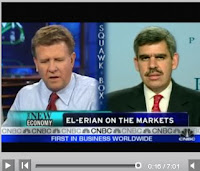
Marc Faber, also called Dr. Doom, sees a strong rally happening very soon, because of all the money that governments are throwing at the broken system. He also thinks if the rally does not happen the economic downturn will be worse than the Great Depression.
Marc Faber said on CNBC Friday:
But "I assure you if you throw enough money at the system, eventually you can reflate, especially in the United States," Faber added.
Statistically a rebound should happen, but if it doesn't "the air is out" and the world faces an economy "worse than the depression of '29 to '32," he said.
source: El-Erian on the Markets
CNBC
http://www.cnbc.com/id/15840232?video=935557926
source: Strong Rebound Coming in Next 3 Months: Dr. Doom
CNBC
http://www.cnbc.com/id/27834889
Wednesday, November 19, 2008
Poole at The Cato Institute's Annual Monetary Conference
 William Poole, Senior Fellow at the Cato Institute, and Former President Federal Reserve Bank of St. Louis, is speaking at a panel during the Cato Institute 26th Annual Monetary Conference on Lessons from the Subprime Crisis and The Way Forward. He identifies excessive leverage at the private sector as the main culprit for the financial crisis and warns of overreaction in the form of over-regulation which is undesirable in his view.
Poole is suggesting to tackle the tendency of excessive leverage by the private financial sector by changing the tax code (I kid U not) and give fiscal incentives to participants who lower their leverage ratios. What a crazy suggestion. There's no method in this madness since this libertarian think tank obviously resorts to tax cuts whenever there is trouble on the horizon and fails to recognize the obvious: changing the statutes of the Federal Reserve, who's misguided monetary policy is responsible for the current crisis, can help to solve it.
source: Cato Institute 26th Annual Monetary Conference, Lessons from the Subprime Crisis
Cato Institute
http://www.cato.org/events/monconf2008/index.html
The Big Three - another break in the bailouts
Volatility is returning into the EUR/USD exchange market as a bailout of the auto industry becomes increasingly elusive. Senate majority leader Harry Reid acknowledged that congressional efforts to rescue Detroit's Big Three might falter. The White House also quickly denied any desire to step in. In that case it would be up to the new administration to take action.
It is hard to see how in this climate of multibillion dollar bailouts of Wall Street banks, a $25 billion cash infusion into the auto industry seems to be an overreach. After all Washington is populated with monetarists these days. After Lehman this could become the second assault on global financial markets (in particular financial markets in Europe) which inquisitive minds could view as Washington's financial equivalent of declaring war on the Euro currency. Maybe to trash a potential rival reserve currency is the only way out for a beleaguered US dollar!
click to enlarge
source: Democrats seek to lower expectations for bailout
AP, Wednesday November 19, 2:06 pm ET
http://biz.yahoo.com/ap/081119/congress_autos.html
Japan tackles hot topic - Tbonds denominated in foreign currencies
Yesterday, we got the Treasury International Capital (TIC) flow numbers which underscores an interesting development in recent weeks and months. In all this upheaval of the financial crisis all asset classes declined except the USD and US short and long dated government bonds, which actually increased in value. Brad Setser in his excellent blog for the Council on Foreign Relations (CFR) breaks down the numbers and concludes that "foreign demand for any US bond with a smidgen of credit risk has disappeared".
"Normally, this kind of fall-off in foreign demand would be associated not just with a credit crisis but also with a currency crisis. ....The US, though, isn’t a normal country. The fall in demand for risky US assets was offset by a rise in demand for Treasuries and the sale of foreign assets by Americans."
To illustrate the point click to enlarge the chart
Granted Treasuries are perceived as risk free, yet even Setser admits that "holders of long term Treasuries are clearly holding a lot of currency risk". In this context Yves Smith from the excellent blog "naked Capitalism" picks up an interesting piece of news coming form Japan.
Japanese economists are increasingly concerned with the ability of the United States to finance its enormous deficits. Credit default swaps on the benchmark 10-year contracts on Treasuries have risen to 42 basis points from below two basis points at the start of the credit crisis in July 2007. While Setser still calls this an Armageddon trade foreign officials are not taking it in stride.
Many believe that the dollar looked strong in recent weeks for technical reasons. Money that US financial firms had invested abroad are being repatriated which caused a demand for dollars. Once this subsides there could be a run on the currency. Even if this is exaggerating the situation and we only see a substantial devaluation of the USD, foreign officials will not like to see their Treasury holdings decline in value. This is why economists in Tokyo are now calling for the new administration "to issue US Treasuries denominated in yen and other currencies".
The inevitable consequence of a lack of trust in US financial assets could be that Japan, China and other emerging market central banks will eventually reduce their holdings of US Treasuries. The so called sovereign wealth funds (SWFs) contributing to global capital flows is also increasingly unlikely since those countries will have to fight their own demons on their own turf. The only way to reduce foreign currency risk for the financiers of the US current account imbalances seems to come from US Treasury bonds denominated in foreign currencies. This will not change until the US and global economy are on a clear trajectory to recovery which might not occur for another year or two...and even then it is far from certain that investors will again bestow their trust in US financial leadership.
Yves Smith also delves into the interesting issue of motivation for Japan to tackle this hot topic, after all the author writes, "if America's good buddy and military protectorate is making noises about foreign currency Treasuries, it is hard to dismiss the idea out of hand".
source: You know it is a crisis when the trade deficit could have been financed just by selling t-bills to China and European banks
CFR, by bsetser, posted on Tuesday, November 18th, 2008
http://blogs.cfr.org/setser/2008/11/18/you-know-it-is-a-crisis-when-the-trade-deficit-was-financed-by-selling-t-bills-to-china-and-european-banks/
source: Japanese Float Idea of the Treasury Selling Yen-Denominated Debt
naked capitalism, Wednesday, November 19, 2008
http://www.nakedcapitalism.com/2008/11/japanese-float-idea-of-treasury-selling.html
original news source: Japan economists call for 'Obama bonds'
By Kosuke Takahashi, Asia Times
http://www.atimes.com/atimes/Japan/JK19Dh01.html
Tuesday, November 18, 2008
How far will the S&P500 fall?
The first phase in the corrective trend in Elliott wave movements has bottomed. A second wave is about to start once the severity of the current recession will be realized.
click to enlarge
Saturday, November 15, 2008
President-elect addresses the nation via YouTube
President-elect Barack Obama in his weekly address to the country has broken new ground again. 75 years after FDR used a new medium to reach out to his fellow citizens the new president has chosen a new messenger, more appropriate for the 21st century, the video sharing website YouTube.
Today's address concerns the current economic crisis:
Tuesday, November 11, 2008
Merrill CEO Thain recalls 1929!
The man who won praise as Wall Street's Mr. Fix-It , Merrill CEO John Thain, says that the current economic environment more closely resembles 1929, the year of the start of the Great Depression. He become CEO of the battled Wall Street firm Merrill Lynch in September 07 and was one of the very few who early on recognized the severity of the downturn. Now he predicts a long and severe recession unlike anything we have seen in recent past.
"Although things are starting to improve, this is going to be a long process, and this is not going to get better quickly," he added. "It is not like '87, it is not like '98, it is not like 2001."
source: Merrill CEO says economic environment recalls 1929
Reuters, Tuesday November 11
http://biz.yahoo.com/rb/081111/business_us_merrill_thain.html
Will China's $586 billion dollar stimulus plan work?
China is jumping on to the stimulus train with a massive economic stimulus package. The government announced last Sunday that it would boost its economy with a RMB 4 trillion ($586 billion) capital injection. Stock markets around the globe cheered with the SSE Composite surging more than 7%. Though excitement was short lived and markets were again in the red the following day.
Some analysts see the impact of the stimulus plan between 1 and 2 percent of GDP in 2009 (see Pettis, Nov. 11) and others have criticized it outright as being not effective enough. Among those is Mr. Pettis, economics professor at Peking University's Guanghua School of Management. Prof. Pettis is an expert in Chinese financial markets and he protests the argument of the Chinese government that the fiscal stimulus plan is intended to offset flagging external demand similar to the successful 1998 fiscal expansion. In his opinion the Chinese economy has dramatically changed since 1998 rendering the current plan less effective.
Pettis, Nov 11:
But, as I argue in Sunday’s entry, conditions have changed dramatically. First, China’s GDP is about 2.5 times bigger today than it was back then, and exports have grown much faster than GDP, so China is far from being a “smallish” country. More importantly, the world is looking for more demand right now, not more supply. In a global system with so much excess capacity, and with a marked tendency to excess savings (Americans have to save more, Asians don’t want to consume more), I am a lot more pessimistic about the domestic impact of China’s fiscal expansion, especially if the goal is to increase investment. The world will not simply absorb a lot more Chinese capacity. This package is only useful to the extent that it boosts real demand, especially if it boosts household demand, but that doesn’t seem to be in the cards.
The rush of Chinese officials to implement the plan is also of concern for Mr. Pettis. He suspects it is partly intended as "a shock to confidence" because the economy might be actually in worse shape than the numbers seem to suggest. Another reason might be the upcoming G20 meeting where China faces additional challenges. For a pragmatist like me this is naturally on top of the list. In any case we have no crystal ball and we have to wait and see how it plays out. The odds are certainly not in favor of this massive stimulus package rescuing the Chinese and the global economic malaise.
Pettis, Nov 11:
Of course part of the rushed timing is probably to head off potential trouble at the upcoming G20 meeting. By announcing such a large headline package, China can argue that it is contributing both to the global monetary easing as well as to global fiscal expansion. This will take the pressure off other demands – for example one way China can contribute to global expansion is by a more radical reforming of the currency regime, and it clearly does not want to do that. October’s trade surplus – announced today – was 20% higher than September’s all-time record. This won’t make it easier to argue that they desperately need to keep the RMB from rising too much.
source: The RMB 4 trillion fiscal engine seems to be losing steam (My Blog)
By Michael Pettis, Nov 11
http://piaohaoreport.sampasite.com/china-financial-markets/blog/The-RMB-4-trillion-fiscal-packag.htm
Thursday, November 6, 2008
ECB cut IR by 50 bp - is not precommitted
ECB cut IR by 50 bp and lowers outlook for growth and inflation. In the QaA Trichet continues to point the way for 21st century central banks with a pragmatic approach to the level of IRs to guarantee macroeconomic stability.
The Federal Reserve has to follow the ECB by approaching interest rate decisions with more pragmatism and less preemptive precommitment. It will become the new paradigm for all central banks!
Q, On the question if the governing council is now trying to get ahead of the curve by slashing interest rates:
We are pragmatic and we look at facts and figures. (Trichet was referencing to ULC and employee compensation costs which have much increased over the last years) We are doing what is good at any given time without being hampered by being precommitted.
Q, on the role of central banks in general:
We are all doing what is expected under this exceptionally difficult circumstances
Q, Is there more discipline in macropolicy necessary?
We have to take into account to introduce a new framework that would permit to avoid the persistence of very big imbalances both domestic and external. An appropriate level of surveillance and discipline is lacking and has to be reintroduced.
click for QaA
From the introductory statement:
Looking forward, recent sharp falls in commodity prices, as well as the ongoing weakening in demand, suggest that the annual HICP inflation rate will continue to decline in the coming months and reach a level in line with price stability during the course of 2009. Depending, in particular, on the future path of oil and other commodity prices, some even stronger downside movements in HICP inflation cannot be excluded around the middle of next year, particularly due to base effects. These movements would be short-lived and therefore not relevant from a monetary policy perspective. Looking through such volatility, however, upside risks to price stability at the policy-relevant horizon are alleviating.
There is also some evidence in the September data that the recent intensification of the financial tensions has triggered a slower provision of bank credit to euro area residents, mostly taking the form of smaller holdings of securities. At the same time, for the euro area as a whole, up to September there were no indications of a drying-up in the availability of bank loans to households and non-financial corporations. In particular, the maturity composition of loans suggests that non-financial corporations continued to obtain funding, also at relatively long maturities. However, more data and further analysis are necessary to form a robust judgment.
To sum up, the intensification and broadening of the financial market turmoil is likely to dampen global and euro area demand for a rather protracted period of time. In such an environment, taking into account the strong fall in commodity prices over recent months, price, cost and wage pressures in the euro area should also moderate. At the same time, a cross-check of the outcome of the economic analysis with that of the monetary analysis confirms that the underlying pace of monetary expansion has remained strong but has continued to show further signs of deceleration. Hence, when taking all information and analysis into account, there is a further alleviation of upside risks to price stability at the policy-relevant medium-term horizon, even though they have not disappeared completely. At this juncture, it is therefore crucial that all parties, including public authorities, price-setters and social partners, fully live up to their responsibilities. The level of uncertainty stemming from financial market developments remains extraordinarily high and exceptional challenges lie ahead. We expect the banking sector to make its contribution to restore confidence. The Governing Council will continue to keep inflation expectations firmly anchored in line with its medium-term objective. In so doing, it supports sustainable growth and employment and contributes to financial stability. Accordingly, we will continue to monitor very closely all developments over the period ahead.
source: Jean-Claude Trichet, President of the ECB,
Lucas Papademos, Vice President of the ECB
Frankfurt am Main, 6 November 2008
http://www.ecb.int/press/pressconf/2008/html/is081106.en.html
http://www.thomson-webcast.net/de/dispatching/?ecb_081106_stream_video


